A philosophical essay by the sweet Tikami
The Fear of No-Hell
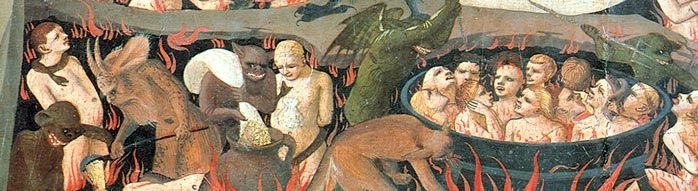
The fear of hell has been, and still is for certain devout souls, religion’s principal lever for pushing human beings to keep their faith and love toward God. For as Saint Alphonse de Liguori puts it in his « Ascetic Works »: « Most men are seen to give themselves over to eternal damnation rather than love God; so who, I ask again, would love Him if there were no hell? Thus the Lord has threatened with eternal torment whoever refuses to love Him, so that those who do not love Him willingly might love Him at least by force, out of fear of hell ». QED.
But what is rather more unusual is the “fear of no-hell”: that haunting dread, shared by a good many believers, that hell might turn out to be empty, or not exist at all. Mind you, this is piety of the highest order, not something granted to just anyone. It takes a truly admirable, conspiratorial closeness with God to feel such an irrepressible need to bless the damnation of one’s fellow man.
For instance, Jacques Fesch, the notorious police-killer guillotined in 1957, during his short but intense final life of faith, fiercely defended the possibility of going to hell. Of course, had God biblically decreed that murder could never be forgiven, “neither in this age nor in the next,” our national good thief would have written his reflections with a rather less steady hand.
We might also mention the hatred directed at theologians who, in the manner of Hans Urs von Balthasar, put forward thoughts bordering on heresy about the Goodness of God and, by extension, the Salvation of All. These modern theses, judged far too humanist and optimistic, find themselves up against entire volumes of rebuttal. Their opponents take it upon themselves to bring back into fashion concepts that are - apparently - far too neglected these days: holy Fear of God and of His Wrath, the terror of hell, the irrevocable condemnation of this or that particular vice…
The appendix on hell, in my book « Les deux visages du christianisme », cites a few examples of the fervour that grips the devout whenever someone tries to take away or soften their hell; for instance, Pierre Gabarra’s furious kicking-back against the “denatured” (that is, far too optimistic) theology of Father André Fossion - a fit of temper you can still find online on the “Hermas” blog.
But one must also note the work of Guy Pagès, with his book « Judas est en enfer » [Judas Is in Hell] (Editions Guibert). Through long meditation on the wretched fate of the “traitor,” on his immeasurable remorse and his suicide, humanity had gradually come to see in him a sinful, fallible human being; just as imperfect as his fellow men, and therefore deserving of great mercy and great redemption. But no such luck: as Mr. Pagès puts it, « If Judas is in Paradise, then who on earth is not? ». A scandalous prospect, promptly settled by the inevitable damnation of the sorry fellow. And the good preacher goes on to remind us: « [If Judas is not damned] then there is really not so much to worry about for your own salvation! Keep right on sinning, good people, the devil will take care of everything! ».
Guy Pagès here spells out a strange intuition shared by many a righteous soul and mystic, Saint Alphonse de Liguori among them: that the foundation of religious morality is not the sensitivity of living beings, nor brotherly empathy, nor any grasp of harmonious life in society, but solely the fear of punishment; and conversely, « If God does not exist, everything is permitted » (Dostoevsky).
The trouble with this ethical approach, which discards rationality in favour of the (supposed) threats of some entity from beyond this world, is that nothing remains predictable anymore. Some monotheists must abstain from cured meats, wine, or music - even water - yet may stone their wives; others dare not switch on a light on a Saturday, yet require genital mutilation and justify biblical genocides; others call themselves pro-life yet forbid blood transfusions; and other good believers base their hatred of homosexuality on the anathemas of the Old Testament - anathemas that also targeted molluscs and crustaceans as so many “abominations.”
How does one keep human beings from asking too many questions about this ever-shifting morality? Simply through deterrence by fear - the fear of acting wrongly, the fear of thinking wrongly, the fear, ultimately, of hell. So that the believers’ love and faithfulness might be obtained “at least by force.” That is why so many mystics cling so tightly to this questionable theory of eternal torture. Without this anti-reflection safeguard, the whole edifice risks collapsing.
 A glimpse of the author, the Tikami