A philosophical essay by the sweet Tikami
Exegesis Explained
Exegesis: the philological and doctrinal interpretation of a text whose meaning or scope is unclear.
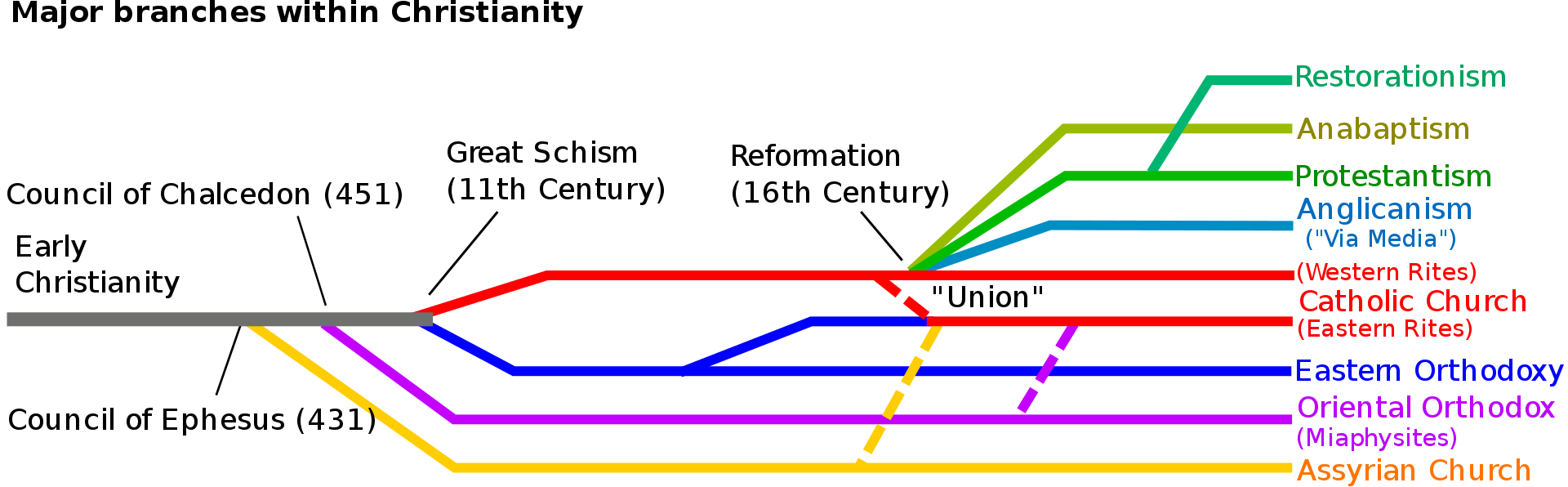
The corpus of “holy books” shared by the Christian denominations is remarkably similar; so how is it that serious, painstaking theological study of these very same texts can arrive at such wildly discordant conclusions? These intellectual divergences actually stem from a handful of very simple mechanisms.
The translation conflict
Surprising as it may sound, the Word of God was sown among peoples whose writing systems were full of gaps (vowels are notoriously hard to render in Hebrew…), and whose languages lacked certain features rather handy for clarity, such as comparatives (more than, less than…).
This produces translations that are sometimes shocking (“Whoever comes to me without hating his father, his mother…” instead of “without preferring me to them”), and sometimes hilarious (speaking of Moses, “his face was horned” instead of “radiant with light,” in Exodus 34:29). Translations which, at any rate, demonstrate the complete absence of “inspiration” on the part of the translators, however pious they may be.
As Jean Joncheray and René Nouailhat note in “Enquête sur les traductions de la Bible” (1999), even the simplest notions end up taking surreal shapes once they pass through translators’ hands: « Take a few Bibles, among the best-known or most widely used. Compare the different versions of the opening of Genesis. At the creation of the animals, in verse 21 of the first chapter, the great fish (Segond 2, the Polyglot, Français Courant, Jehovah’s Witnesses) become great sea creatures (Frossard), great sea monsters (TOB), great dragons (Dhorme), great sea serpents (Jerusalem Bible), great cetaceans (Bible of Alexandria), enormous cetaceans (Jewish Bible), great aquatic animals (Crampon), enormous sea monsters (Segond 1), or great crocodiles (Chouraqui)! »
« Every translation is a betrayal », some claim. Where the Bible is concerned, this has become an empirical fact.
The conflict of reading level
Even when there is no possible controversy over the meaning of a biblical passage, Christians can still hold starkly discordant opinions about its relevance. For, as everyone knows, the patchwork of texts gathered into the Bible underwent a thoroughly chaotic assembly; with texts added, mixed together, removed, depending on the whims of popular upheavals, on later selections (the ejection of the apocryphal gospels…), and on a succession of translations – from dead languages into nearly-dead ones. The whole thing is remarkably short on certainties, whether regarding the chronology and source of the texts, or the literary register in which each should be read.
Depending on what one is trying to prove, it is therefore easy to play with these levers. Does a word bother us? It is a “later addition,” a “metaphor,” or (coming back to the previous point) a translation error. Does it interest us? Then it becomes the nerve centre of the whole chapter, an expression dictated directly by the Holy Spirit, to the author as much as to every translator who came after.
« But this kind of demon goes out only through prayer and fasting », we read in Matthew 17:21. Some launch into lengthy harangues on the effectiveness of self-denial for obtaining spiritual gifts, while others see in that “and fasting” an intrusive addition, tacked on later, which deceives us by crediting hunger with “martial” or “magical” effects. Who is right, who is wrong?
« Amen, I say to you: no one who has left house, brothers, sisters, mother, father, children, or fields for my sake and for the Gospel will fail to receive, even now in this present age, a hundredfold: houses, brothers, sisters, mothers, children, and fields, along with persecutions, and in the age to come, eternal life. », we also read, in Mark 10:28–31. Amid all the lovely promises, that “along with persecutions” lands like a hair in the soup. Some therefore read it as a clumsy “correction” on the part of the early Christians, a touch unsettled to see martyrdom arriving instead of the promised material and family wealth. But others insist on the opposite: Jesus had indeed warned that, for his followers, the honey would be generously diluted with vinegar. Who is right, who is wrong?
If the history of God’s people is not true, then our faith is in vain, say many a preacher. Hence the necessity of reading the books of the Patriarchs or of Exodus literally, even at the cost of stumbling over rather disjointed chronologies, and over divine interventions considerably less discreet than what goes on nowadays. But then along come others who, carried by the same momentum, also want to take Genesis historically. And so we end up with the endless comedy of the creationists, the members of the “Flat Earth Society,” and other movements seeking to rewrite the History of the Universe from a few myths scrawled on clay tablets or parchments. Meanwhile, the most recent archaeological discoveries seem to undermine perfectly plausible biblical episodes, such as the wanderings of the patriarchs or the Exodus. Who is right, who is wrong?
Modernist currents have little trouble relegating demonic forces and the miracles of Jesus to the rank of mass illusion, while others see, in the all-too-likely massacres attributable to the Hebrew people, mere symbols of our inner spiritual battles. And we are still debating how much truth to grant all the figures put forward by the Bible (only 144,000 elect? Forty days in the desert without food or drink? Methuselah died at what age, did you say?). Who is right, who is wrong?
The theological gaps
Despite its imposing verbosity, the Bible does not answer every question human beings might ask. Let us say it even more plainly: while it details, with infinite care, genealogies, misadventures, and speeches that are either utterly uninteresting or downright appalling, it has taken great care to leave almost unanswered the moral and eschatological questions of humankind; not a single halfway credible moral dilemma is properly addressed in it, and as for the afterlife, we must content ourselves with imagining humans turned “like the angels” (Matthew 22:30) – that is, into something no ordinary human has the faintest idea of. Hence the door left wide open to innovations of greater or lesser divine inspiration.
We learn in the book of Maccabees that Judas Maccabeus « had this sacrifice of atonement offered for the dead, that they might be freed from their sin » (2 Maccabees 12:45). Human and animal sacrifices, ceremonies for every occasion – the Bible is bursting with them. Yet this passage is pretty much the only biblical foundation for the prolific doctrine of Purgatory within the Catholic Church. Similarly, since the holy scriptures never ruled on the fate of stillborn infants, Limbo and a good many other elaborate hypotheses came along to fill that theological gap; certain mystics duly described this “incomplete beatitude” in great detail, until the Holy Office, to everyone’s surprise, reclassified it as an “abandoned theological hypothesis.”
And Catholic Tradition, so reviled by Protestant movements, is not the only one building doctrinal cathedrals on sand; there exists a natural tendency, across every denomination, to extrapolate grand systems from a handful of vague parables or prophecies. Just look, on this subject, at all the predictions (sometimes backed by specific dates – and in that case always contradicted by time), the suspicions (conspiracies, antichrists…), the statistics (how many elect, how long for each phase of the plan?) surrounding the end times; or the proliferating systems built around the question of Evil and suffering; or again the theological pandemonium surrounding communion and transubstantiation: each Christian sub-denomination holds very precise theses on the matter, which sometimes place other denominations at risk of “improper communion” – and therefore of terrible sin.
And so it goes: growing spiritually on “Scripture alone” is the aspiration of many Christians; but without interpretation, this collection does not mean a great deal, and once interpreted, it gives rise to doctrinal edifices that are both enormous and highly unstable.
Cherry-picking
Yet another way to diverge radically in one’s conception of the faith is to focus on different parts of the Bible. Thus the Catholic Church long forbade the personal study of the Old Testament – though it never went so far as to reject it outright, as the Marcionites did. This hefty Hebrew collection is, even today, heavily overshadowed by the handful of books making up the New Testament; and aside from the Ten Commandments, almost the entirety of the laws spelled out in black and white within it (circumcision, ablutions, purity requirements, civil and religious law…) is simply set aside by Christians.
Yet had not Jesus come “to fulfil, and not to abolish”? Had he not promised that not one jot of the law would pass away, until “all is accomplished”? And yet he himself blithely disregarded certain rules concerning the Sabbath or stoning… Between the legalist Jesus and the anti-legalist Jesus (with Saint Paul playing a large part in the matter), the arguments have still not died down. But the facts remain: plenty of laws clearly set out for the Jewish people are today held in contempt by mainstream Christian currents, while others still serve to harshly condemn the tiniest sins of the flesh. And at the same time, a few of the devout go fishing for ancient quotations to promote Zionism or the death penalty.
Jehovah’s Witnesses, in their questionable dogmatism, are more “consistent” than others: the sanctity with which they surround blood (to the point of criminally forbidding blood transfusions) is spelled out from Genesis (« Only you shall not eat flesh with its life, that is, its blood », in Genesis 9:4) all the way to the Acts of the Apostles (« but that they write to them that they abstain from the pollutions of idols, and from fornication, and from what is strangled, and from blood », in Acts 15:20). How dare so many other Christians go hunting for anathemas in the Old Testament, or observe Christian fasting, if they cannot even bring themselves to honour the most recently updated commandments?
And this selectivity operates down to much finer levels still, within the very denominations themselves, and within the biblical passages themselves. Kindly Catholic priests take care to “forget,” in certain choices of readings or in their homilies, the slightly too strong passages of the Bible. For which they get soundly scolded by their fellow clergy, who see in it a disgraceful distortion of the word of God (potentially a mortal sin), on the grounds that this word must be delivered “in its entirety” to act effectively.
Let us also remember that a sufficiently fine-grained selection allows one to play on all the other boards of doctrinal divergence as well, turning a passage of historical narrative into a fulfilled prophecy, an unimportant anecdote into a binding legal rule, or a tale of unrelenting darkness into something fit for a Walt Disney story. Quotations taken out of context, and omissions more or less discreet: a veritable goldmine for theological creativity.
Conclusion: the shapeshifting Bible
Popes have often reminded us: the deadliest heresies will not come from a rejection of the Bible, but from its misinterpretation. Is this sacred book not astonishing, then? The very book that served as the foundation for the greatest monotheistic religions, without ever preventing their infinitely deep disunity? The very book that generated so many dogmas while, in the same breath, sustaining their corresponding heresies? This “theological bedrock,” capable of changing its tune with every paragraph, and of serving as ammunition in favour of absolutely any ideology, from the most angelic to the most demonic?
It seems nobody will ever manage to turn “Mein Kampf” or “La Marseillaise” into hymns to universal love; nor will anyone manage to turn the 1948 “Universal Declaration of Human Rights” into a spearhead for Stalinism or fascism. But the “living word” of God is forged from different stuff altogether. It says less what it has to say than what you want it to say. In it you will always find something to confirm your own ideas, from the sanctioning of human sacrifice to the strict ban on eating pork, from violent homophobia to quiet homophilia (http://www.davidetjonathan.com/), from starry-eyed optimism to bottomless pessimism.
Twist the old historical narratives a little, and you will obtain prophecies proclaiming your own status as God’s Anointed One, or certain punishments earmarked for your adversaries. Do these prophecies fail to come true as planned? No matter: « a biblical prophecy does not carry a character of inevitability, but rather one of warning about what might happen in the absence of conversion ».
Some will see in all this a divine favour, a margin of freedom granted to humankind. Others will conclude that, from one holy war to the next sterile controversy, Christendom might have fared better with a spiritual source a little less prone to shifting shape.
 A glimpse of the author, the Tikami